One of America’s unsung heroes of the 19th century is Thaddeus Stevens. Not many people know his name, but he did more to influence your life than iPhone and YouTube put together.
Named after American Revolutionary War hero Tadeusz Kosciuszko, Thaddeus Stevens was born in Vermont in 1792. He was born with a club foot and limped his whole life because of this condition. At the time, having a child with a club foot was considered a judgment from God for secret parental sin. This and having an older son born with the same condition in both feet may have influenced the boy’s father to abandon his family (even though the family had more children born without any disability), and it was the mother, Sarah Stevens, that was left alone to take care of her kids. She eventually enrolled Thaddeus into a grammar school where he, after being relentlessly taunted for his condition by his classmates, grew headstrong with overwhelming desire to succeed and get an education.
Stevens eventually enrolled into University of Vermont, then later Dartmouth College, and then moved to York, PA to become a teacher in York Academy (today’s York College of Pennsylvania). At the same time he studied law and wanted to pass the bar exam. At the time, local bar had a very peculiar restriction banning anyone who “followed any other profession while preparing for admission” from becoming a lawyer. Ever relentless Stevens took the bar exam anyway but he also brought with him four bottles of Madeira wine, over which the obscure rule was happily retired by members of the board.
His law practice founded in 1816 grew and became highly successful. At some point he represented a slave owner who wanted to get his runaway slave back. Stevens won the case, but he came to regret it so much that he promised himself to never work for slave owners again. At the same time, he got involved in politics and first got elected to Gettysburg borough council in 1822 and later to Pennsylvania House of Representatives in 1833.
Pennsylvania Public School Reform
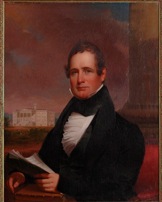
A portrait of a much younger Thaddeus when he was becoming well known in Pennsylvania – Public Domain[/caption]At the time, not a single state outside of New England had free public schools. Parents had to pay tuition, and those who couldn’t had to sign a humiliating pauper’s oath. In 1834 Stevens championed a bill that reformed Pennsylvania school system and introduced free public education to the entire state. Pennsylvania free public school system was first of its kind in the United States and became a model for other states. Of course, conservative backlash against it came fast and strong. In the state election that same year many representatives who voted for that bill were defeated and the repeal of it was all but a certainty. Not to Stevens. On April 11th, 1835 he rose to speak in the chamber of Pennsylvania House of Representatives and delivered a speech of such eloquence that enough people were swayed to now oppose the repeal. In his speech Stevens showed how public school system would actually save money for the state while delivering the greater good of education to everyone. “Pennsylvania’s sons possess as high native talents as any other nation of ancient or modern time. Many of the poorest of her children possess as bright intellectual gems, if they were as highly polished, as did the scholars of Greece or Rome. But too long, too disgracefully long, has coward, trembling, procrastinating legislation permitted them to lie buried in dark, unfathomed caves.” After Stevens uttered these words, the law survived and thus free public schools were born. Massachusetts adopted a similar system five years later and other states gradually followed.
13th Amendment
Despite the enormity of credit that belongs to Stevens for the advancement of the public school system, this isn’t what he’s mostly known for. He became a fervent abolitionist and took that cause with him to the U.S. Congress where he first was elected to in 1848. While there, he joined a radical Republican caucus and was the key force behind the adoption of The Thirteenth Amendment in 1865, which outlawed slavery. Passing that amendment was no easy fit, and its narrow passage in January 1865 was preceded by another passionate speech by Stevens that closed out the debate. “I will be satisfied if my epitaph shall be written thus: ‘Here lies one who only courted the low ambition to have it said he had striven to ameliorate the condition of the poor, the lowly, the downtrodden of every race and language and color.’” The amendment got the required two thirds majority in the House by mere two votes.
Reconstruction and 14th Amendment
It was no time for Stevens to stop. Lincoln was assassinated, and the country had a huge leadership vacuum largely unfilled by the reactionary president Andrew Johnson. Johnson voiced no opposition when Southern States passed draconian Black Codes which deprived the emancipated slaves of rights like owning property and conducting business. Rest of the country, eager to see that all their Civil War sacrifices were not in vain, was quite displeased and gave Republicans overwhelming majorities in the midterm election of 1866. With Radical Republican faction being the largest in the House and Stevens being its leader, he effectively became the most influential congressman. Of course, he wasted no time. Even before that election Stevens started drafting what eventually became The Fourteenth Amendment. To date it is the most litigated constitutional amendment in U.S. history. Its Due Process Clause essentially made Bill of Rights applicable to the states. The Citizenship Clause gave citizenship to descendants of slaves. Today we know this as “birthright citizenship”. The Equal Protection Clause requires each state to provide equal protection under the law to all people, including non-citizens, under its jurisdiction. The Fourteenth Amendment was adopted in 1868 and its ratification along with enfranchising minorities and basically cancelling Black Codes became a prerequisite for all southern states to be re-admitted to the Union. Gritting their racist teeth, they did it and The Fourteenth Amendment became law. Stevens won again, and America did with him. Blacks could now vote in the South, and through the newly obtained majorities in state legislatures in their home states they could do things like establish public school systems that Stevens fought for thirty years ago.
Stevens was in ill health even before the Civil War ended, and by 1868 he couldn’t walk and had to be carried around in a special chair. He died that year. His work largely withstood the test of time, but not entirely. Of course, we still have the constitutional amendments, but southern states found their way around them. After Stevens’ death, Radical Republican caucus lost its influence in Congress, Reconstruction ended after the corrupt election of 1876, and all southern states established poll taxes with grandfather clauses aimed specifically at blacks thus disenfranchising them again. It would only be 90 years later when that would end, but those 90 years were as dark as it gets. The Lost Cause, a whitewashed tale about the Confederacy and Antebellum South, was actively and deliberately romanticized by activist groups like The United Daughters of the Confederacy. Many cities in the South and outside got themselves statues of confederate generals (usually of Robert E. Lee or Stonewall Jackson, but some, like Memphis, TN, erected a statue of Nathan Bedford Forrest, the founder of KKK). Racial oppression manifested itself via rampant lynching, pogroms, and segregation. Despite the fact that the South was soundly defeated in The Civil War, it soundly won Reconstruction. Public image of Stevens in the meantime was painted as that of an extremist and a person filled with hate. Yesterday’s confederates, back in the mainstream of U.S. politics, far outweighed the influence of yesterday’s radicals and shaped the directions of public debate for generations.
Was Thaddeus Stevens an actual radical? He was simply normal. He wanted human beings to be called human beings. He fought for the underprivileged to have an even playing field with the rest of society. He left us some outstanding laws that became a part of our Constitution. Legacy of people like Stevens is so important to remember as we have to resist the tide of authoritarianism. Thaddeus Stevens – America’s hero, my hero.
 Exploring American History
Leave a comment