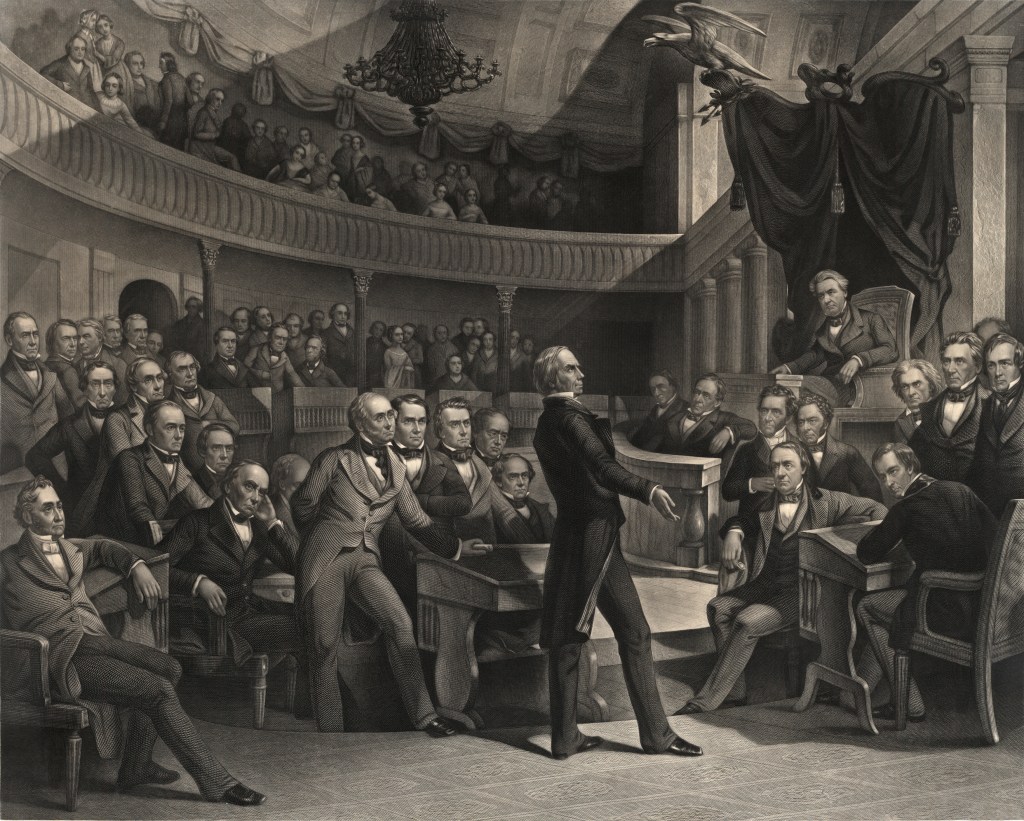
July 11th, 1804. A duel between the sitting U.S. Vice President, Aaron Burr and former U.S. Secretary of Treasury, founder of the First Bank of The United States, military general, founder of U.S. Coast Guard, and the man generally credited with putting the juggernaut of U.S. economy on its feet, Alexander Hamilton, ends in latter throwing his shot and former shooting the latter in cold blood. The occurrence sends shockwaves through the young nation. Two years later, Burr gets arrested on federal charges of conspiracy and stands trial in Richmond, Virginia. A young lawyer named Henry Clay defends him and gets him acquitted. Nonetheless, Burr’s political career is finished, and he ends up leaving the country to avoid additional trials on charges by individual states. Henry Clay, whose career is mildly overshadowed by his association with Burr even despite him later being convinced about Burr’s guilt, has four failed presidential runs and takes part in the Corrupt Bargain after the scandalous election of 1824. But despite his underachievements in the elections, in the next 50 years after Hamilton’s death, it is Henry Clay who embodied the spirit of America like no other politician. That spirit was the spirit of oblique and difficult compromise.
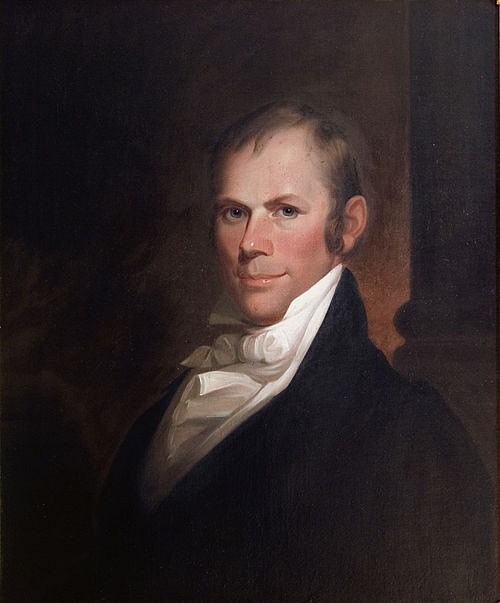
Henry Clay was born in Hanover County, Virginia, in 1777. After studying law under the wing of George Wythe, a signer of the Declaration of Independence and a mentor to Thomas Jefferson, he was admitted to the Virginia Bar in 1797. That year he moved to Kentucky and in 1799 he married Lucrecia Hart, daughter of Colonel Thomas Hart, one the early Kentucky settlers and a prominent businessman. With newly acquired connections, Clay’s law practice grew together with his own standing in the community (defending Aaron Burr for free in 1806 probably helped with that). In 1803, he got elected to the Kentucky state legislature and immediately became one of its most influential members. Such was his influence that despite him being younger than constitutionally mandated age of 30, Kentucky legislature elected him to the U.S. Senate in 1806 to fill a vacancy for a two month remainder of an unexpired term. The same thing happened in 1810, this time for over a year. After two brief stints in the Senate, Clay decided to run for the House of Representatives from Kentucky’s 3rd district and won unopposed. On March 4th 1811, at the start of the new Congress, Clay was elected Speaker of the House. To this day, Henry Clay holds the distinction of the only Speaker in history who was elected on the first day of his first congressional term. As Henry Clay’s political stardom was affirming itself, so did the division lines of the Union.
In the first decade of the 1800s, America found itself entangled in Great Britain’s affairs yet again. Napoleonic wars in Europe were in full swing, and the British were trying to disrupt France’s emerging trade with Americans by intercepting American vessels and impressing many from the captured crew into the service with the British Navy. In response, Congress passed the Embargo Act in 1807 banning all imports from Great Britain and subsequently all exports as well. Even before the passage of the Act, it was clear that it would hurt the economy of Northeastern states the most, because they heavily relied on textile and other manufacturing imports from Great Britain. But since Northeast was the political base of the Federalist Party, President Jefferson, who, just like the majority in Congress, was Democratic-Republican, signed the Act without hesitation. Crippled economy of Northeastern states limped along through the subsequent War of 1812. With no end of the war in sight in December 1814, some disgruntled Federalists, including sizable delegations from Massachusetts, Rhode Island and Connecticut, met in Hartford to decide what to do about their grievances. The convention produced a document that proposed a number of changes designed to even the playing ground between Federalist north and Democratic-Republican south, such as removal of the three fifth compromise, requiring two thirds majorities in Congress to admit new states and to restrict foreign commerce, and limiting presidents to one term.
Union Trembles: The Prelude
No one knows how raucous these proposals would have been because the timing of that convention couldn’t be worse. Earlier in 1814, Henry Clay traveled to Ghent, Belgium, as part of the team led by John Quincy Adams, to negotiate the peace in the War of 1812. Negotiations resulted in the peace treaty being signed on December 24th, 1814. In the realities of the early 19th century, the news took about a month to travel across the ocean. In that time, outnumbered American forces led by General Andrew Jackson won a huge victory at the battle of New Orleans on January 8th, 1815. Also unaware of the Ghent peace treaty, the delegates at the Hartford convention kept it going until January 5th, 1815. They were totally unsuspecting that the hated trade embargo against Great Britain was about to vanish in accordance with the new peace terms. The news of American victory in New Orleans spearheaded the patriotic feelings throughout the country, and the news of the secretive Federalist gathering in Hartford, which came out at the same time, was less than welcome. The public latched onto the conspiracy theory that at the Hartford convention the Federalists planned to secede and form a new country out of New England states. Historians couldn’t find any evidence of that, but the perilous light of treason had been cast, and the Federalist Party never recovered from it. It effectively disappeared from the national stage while the Union persevered, hardly batting an eye.
While the Hartford Convention can hardly be considered an upheaval, it was the first occurrence when a number of American states expressed significant grievances with the Union itself.
Union Trembles: Missouri Statehood
In 1803, Thomas Jefferson did what many consider his greatest presidential accomplishment: he nearly doubled the territory of the United States by purchasing the 829000 square miles of French Louisiana territory west of the Mississippi River. It was an extraordinary achievement indeed, not just because of the sheer size of newly acquired land, but also the purchase price. The American delegation in France was only authorized to purchase the city of New Orleans for a maximum of $10 million. It was at that time however, that Napoleon decided to give up his plans for the empire in the New World, and with the ready buyer at his door, he impulsively let his whole vast territorial possession go for an astonishing price of $15 million (roughly translating to just seven cents per acre), which Americans didn’t think twice to accept.
It was only a matter of time for the new states to be carved out of the newly acquired territory, and that presented a bit of a time bomb. The United States was founded on a delicate balance of power between free states and slave states, with the latter heavily reliant on the reprehensible three-fifth compromise. Other than the ugly concept of valuing a human life for less than what it is, it gave slave states unfair advantage by giving them hundreds of thousands of free votes. That in turn led to slave states being overrepresented in the House, and with the additional help of sympathizers from the North, slaveholding interests were always protected in the U.S. Congress. Free and slave new states were being added to the Union in equal numbers since 1792. That year, Kentucky, a slave state, and Vermont, a free state, were added followed by Tennessee, a slave state, in 1797, Ohio, a free state, in 1803, Louisiana, a slave state, in 1812, Indiana, a free state, in 1816, Alabama, a slave state, and Illinois, a free state, both in 1819.

This was when the territory of Missouri petitioned Congress for statehood as a slave state. It was the second state carved out of the former Louisiana territory, but unlike the state of Louisiana, admitted in 1812 and located in the Deep South, it was situated squarely in the middle of north and south. It was the moment for the northern members of Congress to draw the line: if slavery was not restrained here and now, it would be given a free entry into the entire former territory of Louisiana thus irreversibly changing the fragile balance. At the moment, there were 11 free states and 11 slave states. While voices against slavery were getting louder, southern states didn’t mind slavery as long as it brought them economic benefit. King Cotton was making southern states quite prosperous, but its overproduction depleted the soil and made westward expansion ever more desirable, and with it the continuous reliance on slave labor, which at the time had been a part of the picture for nearly two centuries. The territory of Missouri in particular had traditions of slavery since 1720, and its slave population was rapidly growing since 1793, the year of cotton gin’s invention. Requiring Missouri to somehow disengage from slavery in order to join the Union set the stage for a collision course. And it took no time for Congress to get into it. Shortly after the floor was open for debate on Missouri statehood in February 1819, representative James Tallmage Jr. of New York, a Democratic-Republican, introduced an amendment requiring no further introduction of slavery as well as all children born after the admission to be free at the age of 25, both as a condition for admission. This split Democratic-Republicans for the first time since the start of the Era of Good Feelings, with Northern Democratic-Republicans teaming up with the remnants of the Federalists, and Southern Democratic-Republicans uniting in opposition. Rancorous debate ensued with both sides threatening civil war. Threats of disunion were flying about rampantly and aggressively. Tallmadge proclaimed: “If a dissolution of the Union must take place, let it be so! If civil war, which gentlemen so much threaten, must come, I can only say, let it come!” The House narrowly passed both of his resolutions, however, they failed in the Senate, and the fate of Missouri statehood and the Union itself hung in the balance. However, the Congress was ending its term at the time, and it was up to the next Congress to decide the fate of this legislation.
After returning from Belgium, Henry Clay dove right back into serving in the House, where he was elected speaker again in 1815. He had an incredible run in the House where he was elected seven times between 1810 and 1824 and served as a Speaker of the House until 1820, including the time of Missouri Statehood debate, and then again in 1823-1825. A slaveowner himself, Henry Clay held, shall we say, complex views on slavery. Kentucky, Clay’s home, was a slave state, but it maintained strong economic ties with the North. In the Civil War, Kentucky ended up as a border state, and even though it declared neutrality at first, it ultimately decided to stay with the Union and generally had no qualms about letting slavery go. Henry Clay was certainly an embodiment of Kentucky’s border spirit. He supported gradual emancipation of slaves and a strategy of “diffusion” where slave population would be dispersed in order to not be overly concentrated in any particular area (from that perspective, situating slaves in Missouri would be a good thing).
In December 1819, the district of Maine, part of Massachusetts at the time, petitioned Congress for statehood. The Senate quickly passed a bill admitting both Maine and Missouri as well as all provisions banning slavery in Louisiana territory above 36’30” line (Missouri’s southern border). Henry Clay took that bill up for a vote in the House. Despite him bullying and cajoling as many members of Congress as he could into voting yay, the bill still failed. At that point, Clay formed a committee on compromise where he forced each member to take a vote on the compromise bill in the open and unsurprisingly, the passage in committee was unanimous. After that, Clay split this bill into three bills and introduced each one on the House floor separately. He used parliamentary tricks to outfox the opponents of the compromise, and at the end each bill passed: Maine was admitted as a free state, an enabling act was passed to allow Missouri to join as a slave state, and slavery was banned west of Missouri and north of 36’30” line. On March 6, 1820, President Monroe signed all three bills into law. However, this wasn’t the end of it. Missouri inserted a clause in its state constitution, written in 1820, that required the exclusion of “free negroes and mulattoes” from the state. This was a direct violation of Privileges and Immunities Clause of Article IV of the U.S. Constitution. In 1821, Missouri still had to get confirmed for admission as what was passed in 1820 was just the enabling act. The controversial clause in its constitution flared the tempers again, and it threatened to derail the admission and re-ignite all the divisions. Representative William Eustis of Massachusetts introduced a resolution in the House requiring that Missouri remove the offensive language. Henry Clay moved the resolution off the House floor and sent it to a select committee on compromise, members of which he named himself. He feared that if Eustis’ resolution gets adopted, it would be not only Missouri that leaves the Union, but also Kentucky, Tennessee, and even Ohio. The committee on compromise ultimately reported that Missouri be admitted to the Union upon the fundamental condition that its legislature would not enact any law preventing any description of a person from settling in Missouri who could otherwise become a citizen of any other state in the Union. But even that wasn’t the end of it. It was now time for the 1820 election, and the question came up: would Missouri votes be counted? Missouri wasn’t technically a state yet, but every southern lawmaker basically considered it one. When setting up the order of states during the count of electoral votes, Clay, in yet another show of his political ingenuity, moved Missouri’s turn in the count to be the last believing that by the time it gets to Missouri, its electoral votes would be perfunctory. He was right: Monroe won the election by a landslide. Subsequently, on August 10, 1821, President Monroe signed the bill containing resolutions put forth by Clay’s committee on compromise after it was passed by both houses of Congress.
Henry Clay’s unexampled perseverance was a key factor that saved the country from disunion and civil war. His stature in national politics greatly improved after the Missouri Compromise as he became a politician of national caliber. He didn’t wait long to capitalize on that as he launched his presidential run in the very next election cycle. Not everyone was happy with the compromise, including Thomas Jefferson, who famously called the compromise “a fire bell in the night” and compared the debate over slavery in Missouri to a “knell of the Union.” His concerns were justified, but no one other than Henry Clay had stepped up to the plate and steered the debate towards a compromise. As it appeared, Henry Clay’s mediating skills and desire to keep the Union going would be needed on a few more occasions. We’ll discuss them in the next post.
 Exploring American History
Leave a comment